Showing posts with label mortgage lenders. Show all posts

Monday, August 15, 2016

Mortgage Rate Calculators

Mortgage Rate Calculator

Many prospective homeowners applying for actend to have two concerns before they agree to sign: How much interest will I end up paying, and can I afford the monthly payments?

Unless you're a robot or mathematical savant, chances are you won't be able to calculate these figures off the top of your head. Luckily, programmers have developed several mortgage calculators over the years that help you quickly and easily answer these questions.
But how do you use these calculators correctly, and to what end? Are all mortgage calculators created equal?
 Commonly Used Terms

Mortgage calculators don't always use the same language. It's very possible you'll see multiple ways of describing the same thing. For example, one calculator might have a space for "APR" while another asks for the mortgage's "interest rate," when in fact these two terms mean the same.
Here's a brief list of the three core elements all mortgage calculators have:
  • Rate/interest rate/APRThis is how much interest accrues on your mortgage each year. Most times the calculator will ask you to enter this amount as a percentage and not a decimal, unless it specifies otherwise. For example, if you have an interest rate of 4.25%, enter "4.25" instead of "0.0425".
  • Principal – This is the face value of your mortgage on day one and represents the total amount of money you haven't repaid yet. If your mortgage is $400,000 on day one, then your principal is $400,000. If you pay $100,000 of that over the next few years, then your principal will be $300,000.
  • Mortgage length/number of payments/amortization period – It's assumed that, if you're using a mortgage calculator, you're using it before you take out your mortgage. If that's the case, these terms will be the same. But if you're midway through paying down your mortgage, you would want to find the "number of payments" by subtracting how many you've made from the total expected number of payments. For example, if you have a 30-year mortgage (360 months), but just finished year two (24 months), then you would have 336 payments remaining (assuming your payments are monthly like most mortgages).
And then there are a few more terms:
  • Loan-to-value ratio –This is a measure of the size of the mortgage compared to the home's value and is directly affected by the size of your down payment. If you take out a $160,000 mortgage on a $200,000 home after making a $40,000 down payment, your loan-to-value ratio is 80%.
  • Private mortgage insurance (PMI) – Lenders will typically require you to buy if your loan-to-value ratio is more than 80% – your down payment was less than 20% of the purchase price – and will continue to charge you this premium until it dips to 78%.
  • Homeowner's insurance – Often bundled with mortgage payments, make sure you know your homeowner's insurance premium every month (or at least make an educated guess if you don't know it yet).
  • Adjustments – If you've taken out an adjustable-rate mortgage, adjustments are how many percentage points your interest rate increases/decreases after a pre-determined period.

What Mortgage Calculators Do

Many would-be homebuyers turn to mortgage calculators to figure out just how much home they can afford.
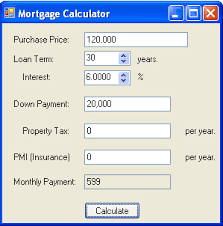
The most common application is finding the estimated monthly payment for your new mortgage. These calculators run complex formulas to account for your principal, interest rate and loan length to determine how much you can expect to pay each month.
 Some calculators have features that show you how much interest you'll pay over the life of your mortgage. Unless you're paying for your house entirely in cash upfront, you might be surprised to see just how much more money an APR tacks onto your mortgage over time.
The most complex and detailed mortgage calculators will include variables for real world expenses like PMI, home insurance, property taxes and more. Others will include options for adjustable-rate mortgage changes as well. These can help you fine-tune your personal finance plans even further, and give you a comprehensive picture of financing a home.

How Calculators Can Save You Money

To be fair, lenders are required to abide by federal law and include a Good Faith Estimate and Truth-in-Lending disclosure when you sign for a loan. These documents reveal your mortgage's APR, finance charges, payment schedule and the total price tag of your loan, assuming you make the minimum monthly payments on time and in full.
However, if you're seeing all of that information for the first time when you sign the loan, then you haven't done your due diligence.
That's where mortgage calculators come in. They can help you understand the bulk of your financial obligations before you sign for the loan. And while good mortgage lenders won't pressure or coerce you into signing, seeing all that information for the first time right before you sign can be a bit overwhelming.
In addition, these calculators can help you compare the pros and cons of mortgages of lengths, terms and interest rates, to help you develop long-term plans for financing your home.


Mortgage for Refinancing

Mortgage Lenders for Refinancing

Mortgage refinancing involves taking out a new loan to pay off your existing home mortgage. As of April 2016, mortgage rates were hovering near record lows. Refinancing makes sense if you took out your existing mortgage when interest rates were much higher. For homeowners with good credit and payment histories, 30-year mortgages are available for under 4% interest, and 15-year mortgages are under 3%. If your current rate is 5% or above, you could save thousands of dollars refinancing even after accounting for various fees, such as mortgage origination and a home appraisal.

Another reason to refinance is if your current mortgage has an adjustable rate, meaning the interest rate goes up and down based on economic conditions. These loans sound attractive when you take them out, as their initial monthly payments are usually lower than a comparable fixed-rate mortgage (FRM). However, adjustable-rate mortgages (ARMs) often come back to bite borrowers later, not to mention you lack the security that comes with knowing your payment will never increase. When market rates are at record lows, it makes financial sense to refinance an ARM into an FRM. If you feel refinancing could benefit you, several companies stand out as offering not only the most competitive rates but also the best service and flexibility throughout the refinancing process.

Quicken Loans

Quicken Loans is a Detroit-based lender that has become a household name thanks to an impressive branding effort throughout the 21st century. The company is known for having competitive rates and several unique mortgage products not offered by its competitors. Its YOUR mortgage product offers repayment terms that you can customize beyond the typical 15- and 30-year mortgages provided by most companies. You can choose a term from eight to 30 years in one-year increments. This way you can lower your rate and payment while keeping the time remaining on your mortgage the same.
For borrowers who wish to refinance online without dealing with a salesperson, the Quicken Loans Rocket Mortgage makes this possible. Everything from the initial application and credit check to scheduling your home appraisal is done online. If you get stuck along the way, you still have the option of calling a toll-free number and speaking to a live loan officer. Market research company JD Power named Quicken Loans the number one mortgage company for customer satisfaction in 2015. As of April 2016, Quicken maintains an A-plus rating with the Better Business Bureau.

Guaranteed Rate

Guaranteed Rate is another company that emphasizes the ability for borrowers to conduct a refinance completely online. A unique benefit offered by the company is free credit reporting upon initial application. When you submit your information through the company's website or smartphone app, you receive your credit score from all three major bureaus for free. At this point, you can even choose your interest rate and fee structure based on what your credit qualifies you for and lock it in early in case rates increase. The company's status as an online lender means it has low overhead, and it passes these savings to its borrowers. Guaranteed Rate, as of 2016, was rated A-plus by the Better Business Bureau and received majority five-star reviews on finance and real estate websites such as Bankrate.com and Zillow.com.

loanDepot

LoanDepot is a direct mortgage lender, meaning the company itself provides the funds at closing rather than simply serving as a middleman that farms the loan out to a third-party company. There is one fewer person that has to be paid, which often translates to a better deal. Moreover, the company employs a no-steering policy, prohibiting its loan offers from trying to talk borrowers into a different type of loan to earn a bigger commission check. In addition to low rates, loanDepot gives prospective borrowers the ability to procure an interest rate quote instantly by filling out a simple form on its website. The company is rated A-plus by the Better Business Bureau.


Thursday, August 11, 2016

Mortgage Lenders

Mortgage Lenders
Mortgage borrowers can be individuals mortgaging their home or they can be businesses mortgaging commercial property (for example, their own business premises, residential property let to tenants or an investment portfolio). The lender will typically be a financial institution, such as a bank, credit union or building society, depending on the country concerned, and the loan arrangements can be made either directly or indirectly through intermediaries. Features of mortgage loans such as the size of the loan, maturity of the loan, interest rate, method of paying off the loan, and other characteristics can vary considerably. The lender's rights over the secured property take priority over the borrower's other creditors which means that if the borrower becomes bankrupt or insolvent, the other creditors will only be repaid the debts owed to them from a sale of the secured property if the mortgage lender is repaid in full first.
In many jurisdictions, it is normal for home purchases to be funded by a mortgage loan. Few individuals have enough savings or liquid funds
to enable them to purchase property outright. In countries where the demand for home ownership is highest, strong domestic markets for mortgages have developed. An alternative to mortgages that meets the requirements of Sharia (Islamic law), is the Islamic mortgage. Sharia prohibits interest, so Islamic mortgages are structured to avoid it by using other strategies such as markup of the purchase price.